Compstyle student finds a critical vulnerability in AZTU’s system
20-year-old Ali Alizada found critical flaws in AZTU’s system and reported them responsibly. The university thanked him; the national agency replied.
Compstyle teamOctober 26, 2026 · 7 min read
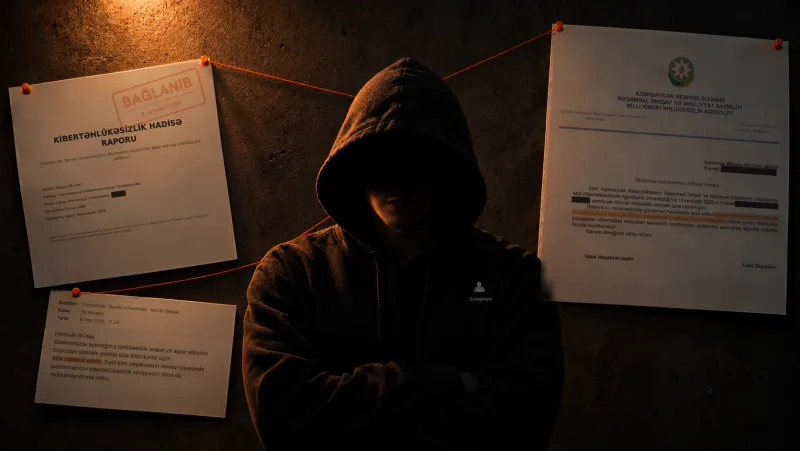
May 5, 2026, 10:12 p.m. Ali Alizada takes his first screenshot in one of his own university’s web systems. What he sees over the next 25 minutes would have scared many people or made them keep quiet: the personal data of tens of thousands of people could be viewed without authorization. Ali was neither scared nor silent. The next day he wrote to the university.
The dates and quotes in this article come from Ali’s official report, the university’s reply and the official response of the National Cybersecurity Agency. The vulnerabilities have since been fixed. Ali has agreed to be named.
Who is Ali
Ali is 20. He is a third-year Information Security student at Azerbaijan Technical University (AZTU). For him, knowledge doesn’t end with an exam grade – he wanted to prove what he had learned in real life.
That is why he joined Compstyle’s Red Team course, taught by cybersecurity instructor Farid Balametov. In Red Team you learn to look at a system through an attacker’s eyes: where the weak spot might be, which way someone with bad intentions would get in. Most importantly, you learn how to document what you find, and whom to report it to and how.
From the very first day of the course, Ali was one of those students who wanted to try everything he learned in practice right away. One day that drive led him to the closest system of all – his own university’s. His goal was clear: to make the place where he studies safer.
What he found
In one of the university’s internal web systems, Ali discovered six interconnected vulnerabilities. No lock had been picked: some doors had simply been left open.
Professional reports name vulnerabilities with international terms and CWE categories. Ali’s report does the same:
- Directory ListingHighCWE-548Folders on the server were open like a shop window: anyone could see the list of files inside them from a browser.
- Source Code DisclosureCriticalCWE-540The code running on the site’s back end could be downloaded as an ordinary file. For an attacker, code is a map of the system.
- Information DisclosureMedium–HighCWE-209Error messages revealed more than necessary about the server’s internal structure.
- Broken Access ControlCriticalCWE-284An old admin interface that was no longer in use was not properly protected.
- Credential ExposureCriticalCWE-522There was a risk that login credentials linked to an earlier incident were still active.
- Mass Data ExposureCriticalCWE-359ID card details, phone numbers, email addresses and admission scores of tens of thousands of people could be viewed without authorization.
Four of the six vulnerabilities were critical. The last one is the most serious. If data like this falls into the wrong hands, people can become victims of targeted phishing and fraud – and the owners of the data would never even find out.
What would you do?
The personal data of tens of thousands of people is right in front of you. Nobody can see you. What would you do?
What Ali did
This is exactly the moment that separates a professional from an amateur. Ali didn’t share the data with anyone or use it for any purpose. He documented only as much as was needed to prove how serious the problem was, hid all personal data in his screenshots – and stopped. Then he notified the owner of the system. In cybersecurity this is called responsible disclosure.
The university’s reply
The next day, May 6, Ali sent his findings as a report to the university’s technical support service. The reply came the same day:
Thank you for the security analysis you carried out on our system and for promptly reporting the vulnerabilities you found. Thanks to the support of professionals like you, we have further strengthened the cybersecurity of our platform. Your responsible approach and technical precision are very valuable to us.
Less than a day passed between the first screenshot and the university’s thank-you.
At the national level
The story could have ended there. But when the new academic year began in September, it turned out the job wasn’t finished yet: the data of newly admitted students was also being added to the system.
Ali didn’t leave things half done. He updated his report: 15 pages, a risk classification of all six vulnerabilities, an impact analysis and seven concrete recommendations. On September 15 he sent it to the country’s main cybersecurity body, the National Cybersecurity Agency (CERT.az).
On October 8 the Agency replied officially, with the electronic signature of the Chairman of its Management Board:
In connection with the cybersecurity vulnerabilities described in the report attached to your appeal, the resource owner has been contacted and the relevant explanation has been provided. In addition, we will investigate the information resources referred to in the report and take the appropriate measures.
Today the vulnerabilities are fixed. The data of tens of thousands of students is no longer exposed.
The whole journey, in short
- May 5Evening: Ali discovers the vulnerabilities and documents them.
- May 6The report goes to the university’s technical support. A thank-you reply arrives the same day.
- Sep 14The updated 15-page report is ready.
- Sep 15The report is sent to the National Cybersecurity Agency.
- Oct 8The Agency replies officially. The vulnerabilities are fixed.
A word from his instructor
Ali’s Red Team instructor, Farid Balametov, holds international certifications from Google, Cisco, Fortinet and other companies. He has taken part in penetration testing projects in Azerbaijan and abroad, and has led several of them. Today he passes that experience on to students in Compstyle’s Red Team course.
At every stage Ali consulted his instructor before sending the report to the university and to the Agency.
Finding vulnerabilities can be taught. The harder part is stopping the moment you find one and knocking on the right door. When Ali spotted the flaw, his first question wasn’t “what can I do with this?” but “who should I report this to?” For an instructor, there is no better result.
What this story shows
Knowledge alone is not enough. Finding a vulnerability is a skill. What you do with it is character. Ali passed both tests.
Writing a report is a skill too. Both the university and the national agency took Ali seriously because his report was professional: a clear classification, risk levels, evidence and concrete recommendations. That is half of a Red Team specialist’s job.
Seeing it through. He could have sent one email and forgotten about it. Ali followed the issue for five months and made sure the problem was fixed for good.
Let’s also be clear about one thing: testing someone else’s system without permission can be restricted by law. There are permitted places to develop this skill: labs, CTF competitions and companies’ public bug bounty programs. And if you ever stumble upon a vulnerability by accident, follow Ali’s way: stop and report it.
Want to follow Ali’s path?
In the Red Team course you learn from zero to test systems through an attacker’s eyes, assess vulnerabilities by risk level and write a professional report like Ali’s.
If you want to find vulnerabilities legally and get rewarded for it, take a look at the Advanced Bug Bounty course. Lessons are online, in a group or one-to-one, and taught in Azerbaijani.